Toronto’s ambitious environmental goals are reshaping the city’s skyline, one balcony at a time. The Toronto Green Standard Version 4 (TGS v4), implemented in May 2022, is driving a significant shift towards modular balcony systems and pre-fabricated building components, impacting everything from energy efficiency to embodied carbon.
TGS v4 sets stringent energy and emissions targets for new developments. For Tier 1 projects, buildings must consume no more than approximately 135 kilowatt-hours of energy per square metre annually and limit heating demand to 50 kWh/m². Greenhouse gas emissions are capped at 15 kilograms of CO₂ equivalent per square metre annually, with even stricter limits for higher tiers. Furthermore, Tier 2 projects face an embodied-carbon cap of 350 kg CO₂ equivalent per square metre for the combined structure and envelope.
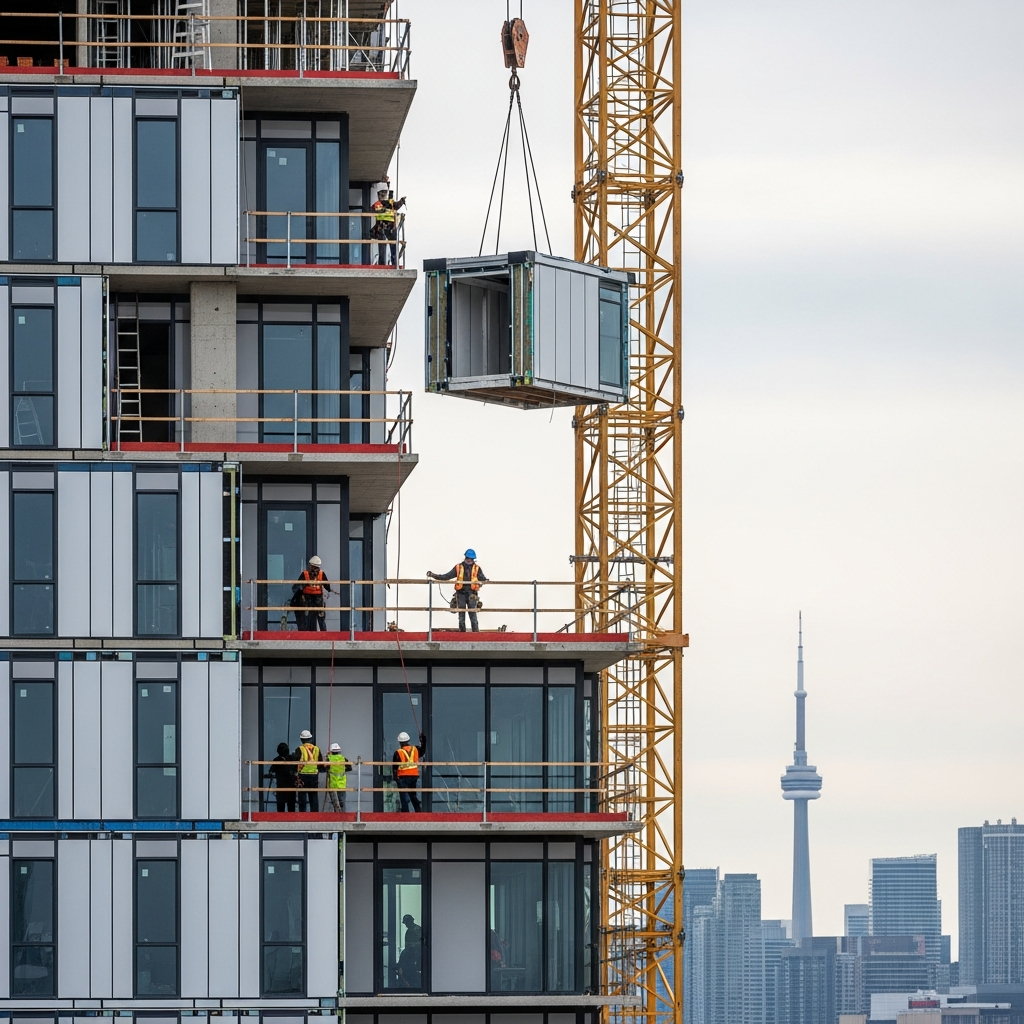
These rigorous standards are forcing developers to rethink building design, with a renewed focus on the building envelope. Slab edges and balcony connections are notorious for thermal bridging, leading to energy loss. Modular balcony systems, often prefabricated with thermal breaks, offer a solution by minimizing heat transfer and condensation risk. Sapphire Balconies, for example, has developed systems that integrate with panelized facades and use thermally isolated anchors to reduce heat transfer.
One notable example of a TGS v4 compliant building is George Brown College’s Limberlost Place. This ten-storey mass-timber building achieved Tier 4 compliance five years ahead of schedule, demonstrating the feasibility of meeting these ambitious targets. The project highlights the importance of early collaboration between architects, engineers, and manufacturers to integrate energy modeling, envelope detailing, and life-cycle analysis.
While the move towards modular construction offers numerous benefits, including reduced waste and improved quality control, challenges remain. Building code variations between provinces can complicate factory scaling, and the transition to modular installation requires new training and union partnerships. Despite the initial cost perceptions, high-efficiency systems offer long-term savings in operating energy and carbon performance, making them a worthwhile investment for the future of Toronto’s green building landscape. As Toronto aims for net-zero building targets, the systems being adopted today will define the city’s sustainability trajectory in the years to come.